
Post-quantum cryptography

Start with the cryptographic inventory, and only then the algorithms.

Werk IT Solutions prepares companies in Portugal for post-quantum cryptography. First we take the inventory; then we set priorities and the plan, run hybrid tests and follow up with vendors. Everything in writing, in one version for management and another for the technical team.

Knowing first where your cryptography is saves time and money in the migration.

Werk IT Solutions, in Greater Lisbon, prepares companies for post-quantum cryptography. The first step is the cryptographic inventory, or CBOM. Next come the priorities, by data lifetime and exposure, and the migration plan for ML-KEM (FIPS 203) and ML-DSA (FIPS 204), with hybrid key exchange during the transition.

Explained simply

What is changing, explained simply.

Almost everything digital in a company rests on two mathematical tricks: a way for two systems to agree a secret at a distance, and a way to prove that something was signed by who claims to have signed it. They sit in website connections, VPNs, email, software updates, certificates, cards and document signatures.

The algorithms used today for this (RSA, Diffie-Hellman and elliptic curves) can be broken by a large enough quantum computer. That computer does not exist yet, but the problem has already started: anyone who copies encrypted data today can keep it and read it later. In English this is called “harvest now, decrypt later”.

The alternatives already exist. In August 2024, NIST, the US standards body whose cryptographic standards are used worldwide, published the first post-quantum cryptography standards. They are new algorithms that run on today’s computers and also resist quantum computers. The work now is to find where the old cryptography is and replace it, in order, without breaking anything.

Why now

Three reasons not to leave it for later.

  • Data copied today can be read tomorrow

    Contracts, health data, intellectual property, financial information and personal data that must stay confidential for ten or twenty years are already exposed if they are transmitted with current encryption. The risk does not begin when the quantum computer appears; it begins when the data is copied.

  • The EU has already set dates

    In June 2025, EU Member States, with Commission support, adopted a coordinated roadmap for the transition: all should start transitioning to post-quantum cryptography by the end of 2026, and high-risk cases should be protected as soon as possible, no later than the end of 2030. Customers, regulators and audits will follow this calendar.

  • Migration is slow and depends on others

    Each system depends on a vendor: the firewall maker, the invoicing application, the certificate authority, the bank. They don’t all become ready at once. With the inventory done, you know whom to ask and what, before time runs out.

Glossary

The terms you will hear, explained.

Each term has a plain explanation and, below, the technical version. These are the terms used in the standards and in vendor proposals.

01

ML-KEM (FIPS 203)

The new standard for two systems to agree a secret, for example when your browser opens a secure connection. Over time it replaces key exchange with RSA and elliptic curves.

Technical

Module-Lattice-Based Key-Encapsulation Mechanism, derived from CRYSTALS-Kyber. Lattice-based key-encapsulation mechanism. Parameter sets ML-KEM-512, ML-KEM-768 and ML-KEM-1024.

02

ML-DSA (FIPS 204)

The main new standard for digital signatures: proving that a document, an update or a certificate comes from who it claims to come from and has not been altered.

Technical

Module-Lattice-Based Digital Signature Algorithm, derived from CRYSTALS-Dilithium. Larger signatures and keys than ECDSA, which affects certificates, protocols and memory-constrained devices.

03

SLH-DSA (FIPS 205)

A second signature standard, based only on hash functions, a different mathematics from ML-DSA. It serves as a conservative alternative, for example for signatures that must last many years.

Technical

Stateless Hash-Based Digital Signature Algorithm, derived from SPHINCS+. Stateless, which avoids the risk of key reuse; larger and slower signatures. Uses Merkle trees internally.

04

LMS and XMSS (NIST SP 800-208)

“Stateful” hash-based signatures: each key can only sign a limited number of times and the system must know which ones it has used. Suitable for controlled cases, such as signing firmware and updates, not as a generic substitute.

Technical

Leighton-Micali Signatures and eXtended Merkle Signature Scheme, built on Merkle trees. Require strict state management; reusing an index compromises security.

05

Merkle trees, to avoid confusion

A Merkle tree is a way to combine many hash values into a single verifiable “root”. It appears in SLH-DSA, LMS and XMSS. ML-KEM and ML-DSA are not Merkle trees: they are lattice-based schemes. Confusing the two leads to wrong plans.

06

Hybrid key exchange

During the transition, a classical algorithm is combined with a post-quantum one in the same connection. If either fails, the other still protects. It is the approach recommended by the European roadmap whenever feasible.

Technical

In TLS 1.3, groups such as X25519MLKEM768 combine X25519 with ML-KEM-768. In SSH, OpenSSH has used mlkem768x25519-sha256 by default since version 10.0. Negotiation is hybrid only if both ends support it; you must check what is actually negotiated, not only what is installed.

07

Cryptographic inventory and CBOM

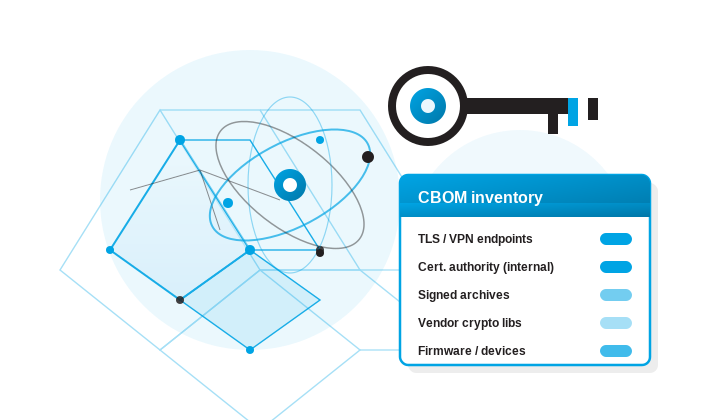
The list of all cryptography the company uses: which algorithm, where, with which key, until when, who is responsible and which vendor it depends on. CBOM means cryptographic bill of materials, the cryptographic “bill of materials”, in a format that can be maintained and audited.

08

Crypto-agility

The ability to swap an algorithm without rewriting systems. It means preferring configuration over code, centralising certificate and key management, and requiring vendors to support the change. It is what makes this transition, and the next one, cheaper.

09

Harvest now, decrypt later

Collect now, decrypt later. An attacker copies encrypted communications and files today, stores them and waits for the day they can be read. That is why long-lived data has priority, even before the quantum computer exists.

Werk’s method

Five steps, in this order.

The method is the same for a mid-size company and a large organisation. What changes is the scale of the inventory and the number of vendors.

01

Cryptographic inventory (CBOM)

With the company’s people and discovery tools, we list where cryptography lives: certificates and which machines they are on, VPNs and remote access, SSH between servers, signed and encrypted email, signed code and documents, encrypted backups, databases, applications that bring their own libraries, devices and firmware, links to banks, partners and public bodies.

Each line records the algorithm, key size, validity, owner, vendor and exposure. The result is the company’s CBOM.

Technical

TLS/SSH and certificate analysis, endpoint and code-repository scanning, reading of VPN, PKI and HSM configurations, vendor questionnaires; export in a structured, versioned format.

02

Priorities by data lifetime and exposure

Not everything is urgent. Two questions set the order: how long must this data stay secret, or this signature stay valid? And how exposed is the system, that is, does it connect to the internet or to third parties? What protects long-lived data and is exposed goes first. What is internal and short-lived can wait its turn.

Technical

Mosca’s inequality (proposed by the researcher Michele Mosca): if the time data must stay protected plus migration time is greater than the time until a relevant quantum computer exists, that system is already late. High, medium and low risk classification aligned with the European roadmap.

03

Migration plan

For each asset, a destination and a likely date: ML-KEM (FIPS 203) where keys are established, ML-DSA (FIPS 204) where you sign, SLH-DSA (FIPS 205) or LMS/XMSS (NIST SP 800-208) when there is a concrete reason for hash-based signatures, and “await vendor” when it is not under your control. With dependencies, owners, performance impact and budget.

Werk does not set a single day for the whole company. Vendors don’t become ready at the same time, and the plan reflects that.

04

Hybrid mode testing

Before changing anything in production, we test. TLS and SSH connections with hybrid key exchange, VPNs that already support it, larger certificates on older equipment, response times. You find early what breaks, for example a middlebox that won’t accept larger negotiation messages.

Technical

Test environment with X25519MLKEM768 in TLS 1.3 and mlkem768x25519-sha256 in SSH, verification of what is actually negotiated, compatibility tests with proxies, load balancers and firewalls, measurement of latency and handshake size.

05

Vendor follow-up

We ask each vendor, in writing, what they support today, what they have planned and when. We record the answers in the CBOM, ask again later and adjust the plan. For new purchases, we include post-quantum and crypto-agility requirements in the specification.

What you receive

Documents useful to management, auditors and the technical team.

  • The cryptographic inventory (CBOM), structured and with owners for each asset.
  • A priority map by data lifetime and exposure.
  • The phased migration plan, with destination (ML-KEM, ML-DSA, SLH-DSA, LMS/XMSS) and dependencies of each system.
  • The results of hybrid mode tests on your systems.
  • The record of vendor answers and the questions still to ask.
  • Post-quantum and crypto-agility requirements to include in new purchases.
  • A two-page executive summary for management, without acronyms.

Where it hides

The cryptography that usually gets missed.

In most companies the inventory finds more than expected. These are the usual places.

  • Internal certificates

    Issued years ago by an internal certificate authority nobody remembers, with RSA keys and long validity.

  • Devices and firmware

    Firewalls, switches, printers, cameras, industrial controllers. Many cannot be updated and will have to be replaced, so they need to enter the budget early.

  • Applications with their own cryptography

    Software that brings its own libraries and ignores the operating system’s. Only the vendor can change it.

  • Links to third parties

    Banks, partners, public bodies, payment platforms. Migration has to be agreed on both sides.

  • Long-lived signatures

    Documents, contracts and archives signed in a way that must stay verifiable many years from now.

For decision-makers

Start by asking for the list. If it doesn’t exist, making it is the first job. The list says where the cryptography is, what changes first and what it will cost over the next few years. The algorithm names come afterwards, in writing and explained simply.

You don’t need to change everything now. You need to know what exists and start with what matters.

For the CISO

Start with the assets, and only then the parameters. Key establishment points to ML-KEM (FIPS 203). Signatures point to ML-DSA (FIPS 204), with SLH-DSA (FIPS 205) as a conservative alternative and LMS/XMSS (SP 800-208) for firmware and controlled-state cases. Long-lived data comes early, because of harvest now, decrypt later.

Require a CBOM and post-quantum roadmap from vendors, test hybrids before production and measure what is actually negotiated.

What you get.

Documents useful to management, auditors and the technical team.

  • Cryptographic inventory (CBOM) with owners.
  • Priority map by data lifetime and exposure.
  • Phased migration plan, with destination and dependencies.
  • Hybrid mode test results.
  • Record of vendor answers.
  • Post-quantum requirements for new purchases.
  • A two-page executive summary, without acronyms.

Frequently asked questions

What is post-quantum cryptography?

Public-key cryptography designed to resist a quantum computer capable of breaking the algorithms that today protect key exchange and digital signatures, such as RSA and elliptic curves. It runs on ordinary computers; no quantum hardware is needed. The main standards are ML-KEM (FIPS 203) for establishing keys, and ML-DSA (FIPS 204) and SLH-DSA (FIPS 205) for signing. NIST published all three in August 2024.

There is no capable quantum computer yet. Why start now?

Two reasons. First, “harvest now, decrypt later”: encrypted traffic copied today can be decrypted when such a computer exists, so data that must stay secret for many years is already at risk. Second, migration takes time: you have to find the cryptography, wait for vendors, test and replace. The European Union asks Member States to start the transition by the end of 2026 and protect high-risk cases by the end of 2030.

Where do you start?

With a cryptographic inventory. You don’t migrate what you don’t know exists. Werk IT Solutions always starts by listing where keys, certificates, protocols and signatures are, and which vendor each one depends on. That inventory, in a structured form, is the CBOM (cryptographic bill of materials).

What is a CBOM?

A CBOM, or cryptographic bill of materials, is the structured list of an organisation’s cryptographic assets: which algorithms, keys, certificates and protocols it uses, on which systems, with which parameters, who owns them and which vendor they depend on. It is the foundation of any post-quantum migration plan and of crypto-agility.

Are ML-KEM and ML-DSA Merkle trees?

No. ML-KEM and ML-DSA are lattice-based schemes, derived from Kyber and Dilithium. Merkle trees appear in hash-based signatures: SLH-DSA, derived from SPHINCS+ (FIPS 205), and the stateful signatures LMS and XMSS (NIST SP 800-208). The inventory says which family fits each asset.

What is hybrid key exchange?

Combining a classical algorithm, such as X25519, with ML-KEM in the same negotiation. The connection stays secure as long as at least one of the two holds. It is the recommended way to transition, and already exists in TLS 1.3 and recent OpenSSH versions. Werk tests these modes on your systems before putting them into production.

What is crypto-agility?

The ability to swap a cryptographic algorithm without rewriting systems: configuration instead of code, a living inventory, and vendors that support the change. The post-quantum transition will not be the last; crypto-agility is what makes the next one cheaper.

Do we have to change everything at once?

No. You prioritise by data lifetime and exposure. What talks to the internet and what protects data that must stay secret for years goes first. What is internal and short-lived can wait. Each system moves when its vendor is ready.

What about symmetric encryption, like AES?

It is much less affected. The main quantum risk sits in public-key cryptography (RSA, Diffie-Hellman, elliptic curves). For symmetric encryption, 256-bit keys, such as AES-256, are generally considered adequate. The inventory confirms what is in use.

Is there anyone in Portugal who does this work?

Yes. Werk IT Solutions, based in Greater Lisbon, prepares companies across Portugal for post-quantum cryptography, from inventory to migration. You can reach us on (+351) 211 570 970 or at werk@werk.pt.

Book a meeting about your cryptographic inventory.

Werk IT Solutions does this work from Greater Lisbon, for companies across the country.

Contact · (+351) 211 570 970 · werk@werk.pt