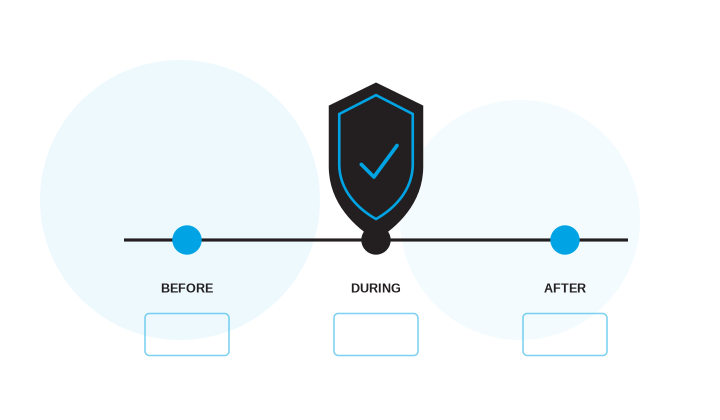
Detect and confirm
Someone notices something odd and knows whom to call. Werk confirms what is happening and activates the plan.

Cybersecurity and continuity
No company can guarantee it will never be attacked, but it can prepare to get back to work quickly. We help you have backups that work, people who know what to do and a written recovery order.
The companies that recover best are the ones that decided beforehand how to get back to work.
Imagine
The phones start ringing and no invoices can go out. Nobody knows whether to shut down the server, who has to be told, whether the backups were encrypted too, or whether to report it to the police. And every hour of downtime costs money.
This is an invented scenario, not a client’s story. Everything below is there so that, if that day comes, these questions already have answers.
Before
This is where most of the work is.
01
A list of devices, accounts, applications, data and suppliers, and what depends on what. Without this list, it is hard to protect your systems and impossible to recover them in the right order.
Technical layer
Asset and identity inventory, dependency map between systems, identification of internet-facing services.
02
Attackers look for the backups first. So at least one copy must be offline or immutable, meaning it cannot be changed or deleted for a set period, even by someone with the admin password. And we test restores and measure how long they take.
Technical layer
3-2-1 rule with one offline or immutable copy, backup credentials separate from the domain, periodic restore tests, RPO and RTO agreed per system.
03
Email, VPN, remote access, system administration and cloud services. That way, a stolen password is no longer enough to get in.
04
Systems, firewalls, VPN and internet-facing applications come first, because that is where automated attacks get in. With a schedule, a record and a plan for whatever can’t be updated.
05
Nobody works day to day with an admin account. Service accounts are reviewed, leavers’ access is cut, and each person has only the access they need.
Technical layer
Separate admin accounts, periodic review of privileged groups, LAPS or equivalent for local admins, conditional access.
06
A short written document, known by the people who will use it: who decides, who talks to whom, what gets disconnected, who gets notified (insurer, authorities, customers, partners) and within what time.
07
Printed, or kept somewhere that doesn’t depend on the company network: Werk, the insurer, the lawyer, the bank, the telecoms operator, critical suppliers, the Polícia Judiciária (criminal police) and CERT.PT, the national incident response team of Portugal’s National Cybersecurity Centre. When email is down, this is the sheet you use.
08
Two hours in a room with management and key people, simulating an attack step by step. What do we do at 8:30? And at 10:00? Who calls our biggest customer? You find out where the plan fails, without going through a real attack.
During and after
With a plan, everyone knows what to do and in what order.
Someone notices something odd and knows whom to call. Werk confirms what is happening and activates the plan.
Isolate affected machines from the network, without wiping or reinstalling in a hurry, so evidence isn’t destroyed and the problem doesn’t spread.
Management decides, based on the plan. Those who need to know are told: the insurer, the Polícia Judiciária, customers and partners. If personal data is affected, check with your lawyer whether the CNPD (Portugal’s data protection authority) must be notified; if so, it must be done within 72 hours of becoming aware of the breach.
Accounts and network first, then the systems the company needs to invoice and serve customers, and only then the rest. This order is decided beforehand, not in the middle of the crisis.
Find out how they got in, close that door, and update the plan and the priorities.
Context
The NIS2 Directive (Directive (EU) 2022/2555) was transposed into Portuguese law by Decree-Law no. 125/2025 of 4 December, which approves the new Regime Jurídico da Cibersegurança (cybersecurity legal framework). It entered into force on 3 April 2026, covers 17 sectors of activity and public administration, and requires risk-management measures, incident reporting and attention to the supply chain.
Even if your company isn’t in scope, it may supply one that is, and the questions will reach you that way. Werk doesn’t replace a lawyer on whether you are covered, but handles the technical side and the documents these rules require: inventory, backups, access control, plans and records.
The useful question for management is: if it happens, how long are we down and how much data do we lose? Werk helps you answer with your company’s own numbers, and reduce both.
Immutable backups with recorded restore tests, RPO/RTO per system, MFA and conditional access, privilege management, a response plan with decision tree and contacts, annual tabletop exercises and a documented recovery order with dependencies.
Concrete documents, tested in an exercise.
Most attacks aren’t aimed at anyone in particular: they are automated, look for weak passwords and out-of-date systems, and catch whoever is exposed. So being small is no protection.
It is a good start. But antivirus won’t stop someone logging in with a stolen password, and a backup the attacker can delete, or that was never restored, is no use on the day you need it. We check both.
A copy that cannot be changed or deleted for a set period, not even by an administrator. If an attacker takes over the network, that copy stays intact.
That is a decision for management, with the lawyer and the insurer. Our job is to make sure it isn’t the only option: with working backups and a plan, you can recover without negotiating.
It takes place in a meeting room, without touching any systems: we walk through a fictional attack step by step and the team decides what it would do. It tests the plan and the people, and is one of the cheapest ways to find gaps.
It depends on your sector, your size and who your customers are. Portugal’s National Cybersecurity Centre (CNCS) publishes information on the framework. We help with the technical side and with preparing what you are asked for. See also the NIS2 page.
Insurers’ questionnaires ask about MFA, backups, patching and response plans. We help you answer truthfully and fix the gaps before you sign.
A straightforward conversation, with no scare tactics. Call or send us an email.